



2025 International Conference on Volatile Organic Compounds Concludes in Guangzhou
Date: November 11, 2025
Publisher: School of Environment and Climate
The International Conference on Volatile Organic Compounds (2025 VOCs Conference) was held in Guangzhou from November 6 to 8, 2025. Co-organized by Jinan University, South China University of Technology, and the Professional Committee on Volatile Organic Compounds Pollution Prevention and Control of the Chinese Society for Environmental Sciences, the event attracted nearly 600 participants, including experts, scholars, industry professionals, and young students from more than ten countries and regions, including China, the United States, Germany, France, the United Kingdom, Italy, Finland, Australia, Japan, South Korea, and India.
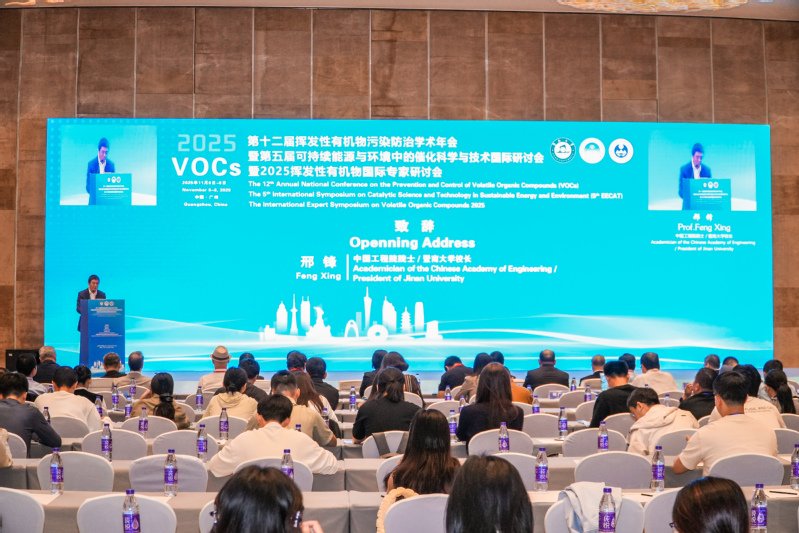
The opening ceremony took place on the morning of November 7. Speeches were delivered by Academician Xing Feng, President of Jinan University, and Luo Shiyan, Deputy Director of the Guangdong Provincial Department of Ecology and Environment. Professor Shao Min from the School of Environment and Climate at Jinan University presided over the ceremony.
In his address, President Xing Feng highlighted Jinan University’s advancements in environmental science and ecology, emphasizing the university’s ongoing commitment to enhancing research initiatives and promoting interdisciplinary collaboration. He expressed his hope that the conference would serve as a platform for in-depth dialogue and collective insight into VOCs governance and green development, contributing to ecological conservation and low-carbon growth in the Guangdong-Hong Kong-Macao Greater Bay Area.
Deputy Director Luo Shiyan underlined the critical role of volatile organic compounds (VOCs) as key precursors to ozone and PM2.5, stressing that their effective control is essential for improving air quality. He noted the phased achievements made by Guangdong Province in VOCs emission reduction through systematic policies and technology-driven approaches. Luo called for strengthened international consensus and cooperation to support science-based governance and environmental improvement.
Following the opening ceremony, ten keynote presentations were delivered by renowned scholars, including Academicians Bao Xinhe, Jiang Guibin, Liu Wenqing, and Zhang Yuanhang of the Chinese Academy of Sciences; Academician Liu Shaochen of The World Academy of Sciences; Professors Donald R. Blake and Alex Guenther from the University of California, Irvine; Professor Jonathan Williams from the Max Planck Institute for Chemistry, Germany; and Professor Mathew Evans from the University of York, UK. Their reports covered cutting-edge topics such as VOCs pollution mechanisms, monitoring technologies, control strategies, and global collaborative environmental governance.
The conference featured 12 parallel sessions, 350 academic presentations, and 50 poster displays. Discussions spanned a wide range of themes, including VOCs instrumentation and measurement, emission characterization and modeling, reaction mechanisms, health effects, the role of VOCs in air pollution and climate change, synergistic control of VOCs and greenhouse gases, catalytic materials and technologies, and the application of artificial intelligence in VOCs research—showcasing the interdisciplinary nature of the field.
During the conference, Lu Chaoyang, Vice Chair of the Professional Committee on VOCs Pollution Prevention and Control, introduced the "VOCs Academic Innovation Award." Established by the Committee, the award recognizes outstanding researchers and graduate students who have made significant contributions to the field. The conference also honored excellent oral presentations and posters by graduate students.
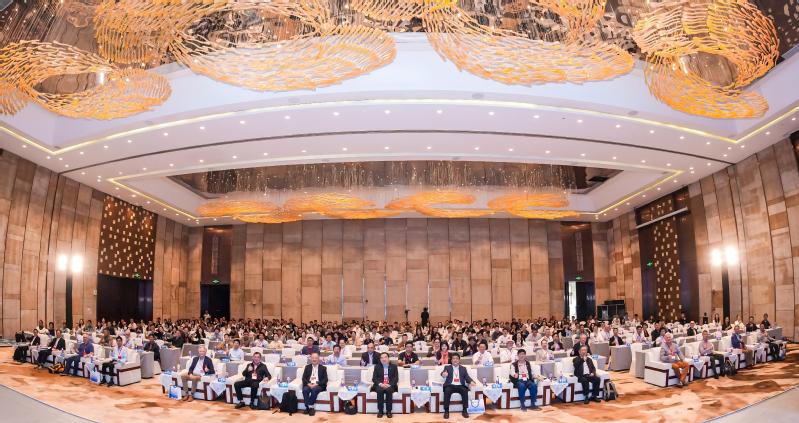
Additionally, nine environmental technology enterprises were invited to showcase their innovations, facilitating exchanges and cooperation among governance experts, environmental authorities, industries, and technology providers.
The conference was supported by the Innovation and Talent Introduction Base for Air Quality Science and Management in the Guangdong-Hong Kong-Macao Greater Bay Area, the College of Environment and Climate of Jinan University, the School of Environment and Energy of South China University of Technology, the Department of Civil and Environmental Engineering of The Hong Kong Polytechnic University, the Joint Laboratory for Collaborative Innovation in Environmental Quality of Guangdong-Hong Kong-Macao, and the Guangdong Nanling Forest Atmospheric Environment and Carbon Neutrality Field Scientific Observation Station.
Edited by: Li Weimiao
NEWS
- About the University
- Quick Links

Copyright © 2016 Jinan University. All Rights Reserved.