



Research Identifies Proteomic Features of KRAS G12-Mutant Lung Adenocarcinoma, Offering New Insights for Immunotherapy
September 30, 2025 – Jinan University Integrated Media Center
Author: Shi Xinyu, Hu Liling
Photographer:: Shi Xinyu, Hu Liling
Lung adenocarcinoma (LUAD) is a leading cause of cancer-related mortality worldwide. KRAS G12 mutations represent a key driver of this malignancy, yet their strong clinical heterogeneity and limited treatment options pose significant challenges. Although integrated proteogenomic approaches have recently provided new insights into tumor biology, systematic studies focusing on KRAS-mutant subtypes remain limited.
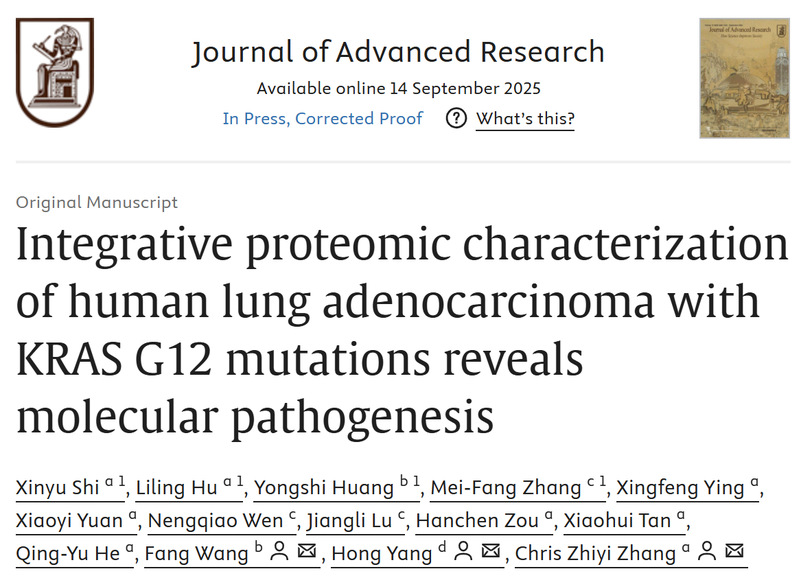
In a study published in the international journal Journal of Advanced Research (CAS Q1, Impact Factor 13.0), a research team led by Dr. Zhang Zhiyi and Dr. He Qingyu from the Department of Biochemistry, College of Life Science and Technology, Jinan University, reported a comprehensive proteomic characterization of KRAS G12-mutant lung adenocarcinoma.
The researchers analyzed next-generation sequencing (NGS) data from 9,479 solid tumors—including 3,523 lung cancers—and performed deep quantitative proteomic profiling on 96 samples comprising both KRAS G12-mutant and wild-type LUAD. By integrating multiplex immunohistochemistry and bioinylated proximity labeling, they systematically mapped the molecular subtypes and tumor immune microenvironment associated with KRAS G12 mutations.
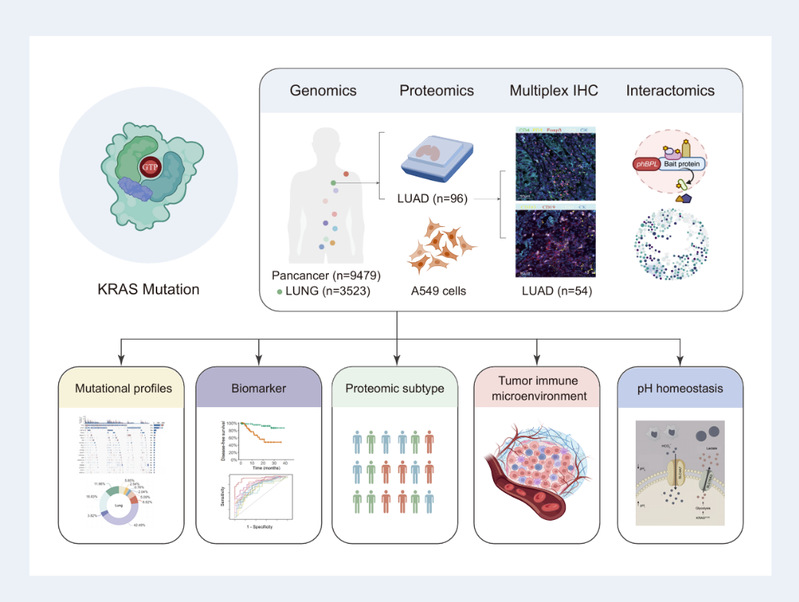
Proteomic clustering revealed three molecular subtypes with distinct clinical heterogeneity. Among these, the immune-modulating subtype—enriched in KRAS G12C mutations—displayed robust immune cell infiltration and activation of tumor-promoting signaling pathways, suggesting that these patients may derive greater benefit from immunotherapy. Further investigation indicated a more immunosuppressive microenvironment in KRAS G12C-mutant tumors and identified the ion transporter SLC4A7 as a potential novel target involved in immune regulation specific to the G12C variant.
This study presents the first systematic proteomic landscape of KRAS G12-mutant lung adenocarcinoma and proposes a molecular subtyping-based model for predicting immunotherapy response. These findings provide a valuable foundation for future clinical trial design and combination therapy strategies.
Jinan University is the first and corresponding affiliation of the study. Graduate students Shi Xinyu and Hu Liling from Jinan University, and Huang Yongshi from Sun Yat-sen University, are co-first authors. Dr. Zhang Zhiyi is the corresponding author.
Link to the paper:
https://www.sciencedirect.com/science/article/pii/S2090123225006976
Editor: Li Weimiao
NEWS
- About the University
- Quick Links

Copyright © 2016 Jinan University. All Rights Reserved.