



Professor Yin Ning's Team at Jinan University Develops Novel Strategy for Spatial Engineering of Single-Crystal Microstructures
Publisher:College of Chemistry and Materials Science
Date: September 30, 2025
Editor: Li Weimiao
A research team led by Professor Yin Ning from the College of Chemistry and Materials Science at Jinan University has successfully engineered the internal microstructure of cuprous oxide (Cu₂O) single-crystal particles using a nanoparticle occlusion strategy. This work provides a new approach for the rational design and spatial control of interface defects in semiconductor materials. The study, entitled "Spatially Engineering the Internal Microstructure of a Single Crystal via Nanoparticle Occlusion," has been published in Angewandte Chemie International Edition, a leading journal in the field of chemistry (Figure 1). Master’s students Yu Bing, Liu Pei, and He Jingjing are co-first authors, with Professor Yin Ning as the corresponding author. Jinan University is the sole corresponding institution.
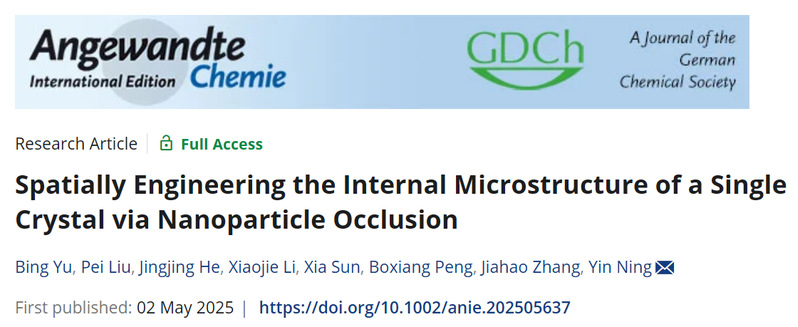
(Figure 1. Screenshot of the published article.)
Single-crystal materials, characterized by their highly ordered atomic arrangement, are of great scientific and technological interest. However, the controlled introduction of impurities or defects into such crystals remains challenging. Building on their previous studies (including multiple publications in Angew. Chem. Int. Ed. and J. Am. Chem. Soc.), the team developed a novel occlusion strategy. By embedding poly(glycerol monomethacrylate)₅₁-poly(benzyl methacrylate)₁₀₀ [G51-B100] block copolymer nanoparticles into Cu₂O crystals, they achieved spatial control over internal composition, lattice defects, and oxygen vacancies (Figure 2). By tuning the concentration of G51-B100 nanoparticles, the researchers systematically adjusted their embedding depth and distribution within the Cu₂O host, establishing a versatile model for studying the correlation between defect spatial distribution and material properties.
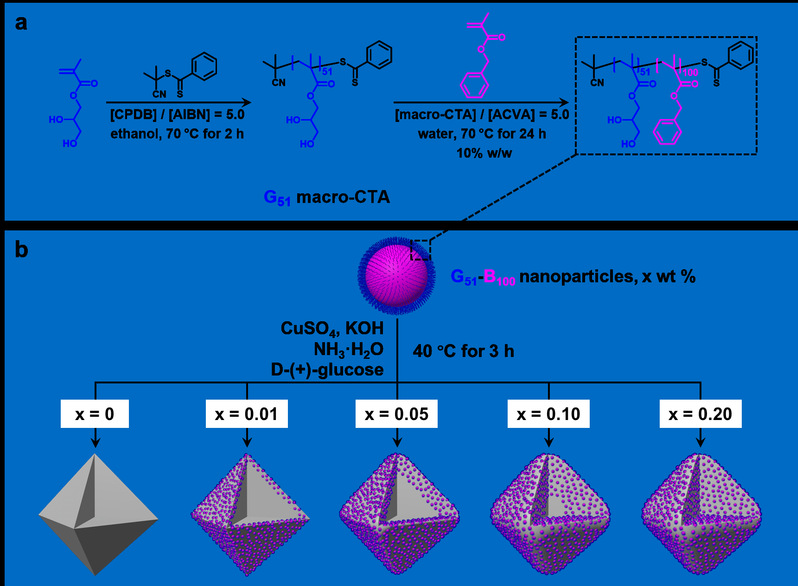
(Figure 2. Schematic illustration of spatially controlled embedding of G51-B100 nanoparticles in Cu₂O crystals. (a) Synthesis of G51-B100 nanoparticles via RAFT-mediated PISA; (b) Tuning the embedding depth by varying the amount of G51-B100 nanoparticles.)
High-resolution scanning electron microscopy (SEM) provided direct evidence of successful nanoparticle incorporation (Figure 3). Cross-sectional images obtained by argon ion beam etching revealed that as the concentration of G51-B100 increased, the embedding depth and extent of the nanoparticles gradually increased, eventually leading to a uniform distribution.
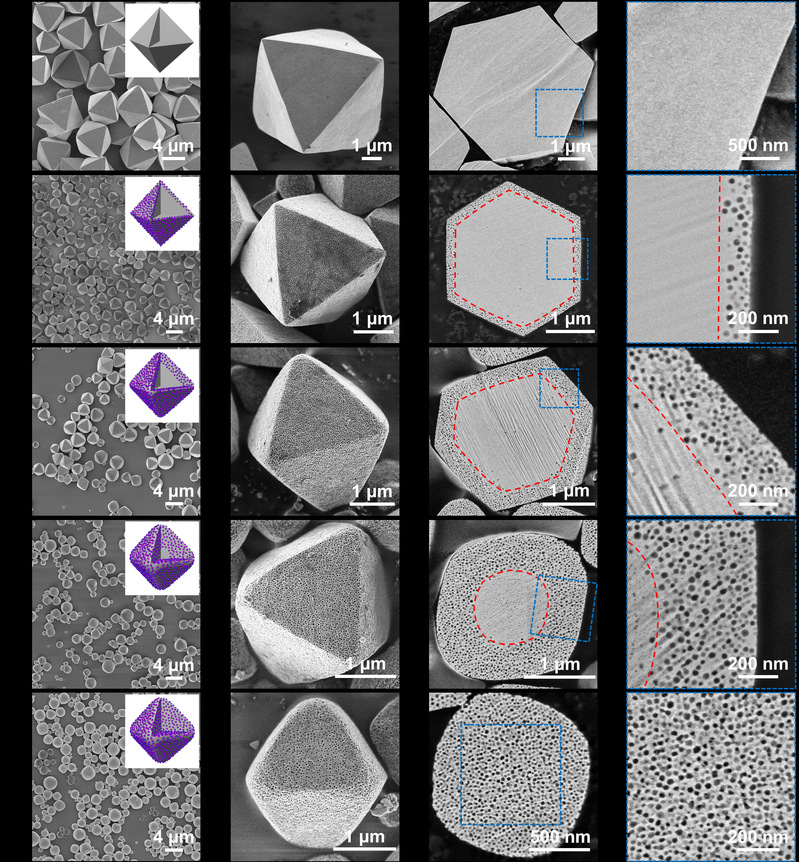
(Figure 3. Spatial distribution of G51-B100 nanoparticles embedded in Cu₂O crystals. Increasing the concentration leads to deeper embedding, eventually achieving uniform distribution.)
Thermogravimetric analysis (TGA) confirmed that the amount of embedded G51-B100 increased with its initial concentration (Figure 4). In uniformly embedded composite crystals, the mass fraction of G51-B100 reached 15.2 wt%, corresponding to a volume fraction of 47.8 vol%, with an average inter-particle spacing of approximately 3 nm. The strong chelation between the cis-diol side groups of the G51 block and Cu⁺ ions is proposed as a key driving force for the efficient occlusion process.
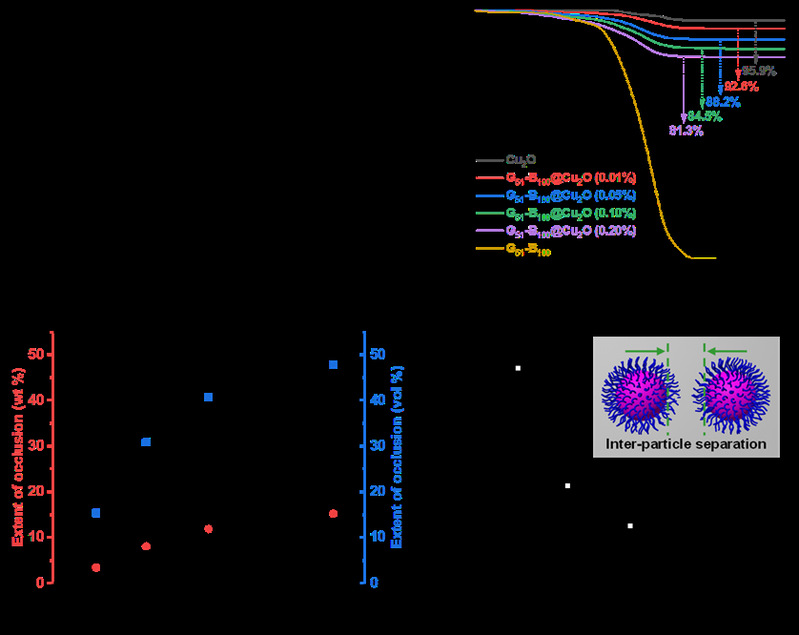
(Figure 4. Analysis of the embedded amount of G51-B100 in Cu₂O crystals. (a) Relationship between relative embedding depth and G51-B100 concentration; (b) TGA results; (c) Embedded amount versus concentration; (d) Average inter-particle spacing as a function of concentration.)
Rietveld refinement of high-resolution synchrotron X-ray diffraction data indicated lattice contraction in the composite crystals, which became more pronounced with increasing G51-B100 concentration (Figure 5). Electron paramagnetic resonance (EPR) spectroscopy showed a corresponding increase in oxygen vacancy content. In addition, X-ray photoelectron spectroscopy (XPS) revealed shifts in the Cu 2p₃/₂ and O 1s peaks toward higher binding energies in the composite crystals, suggesting altered surface chemical environments.
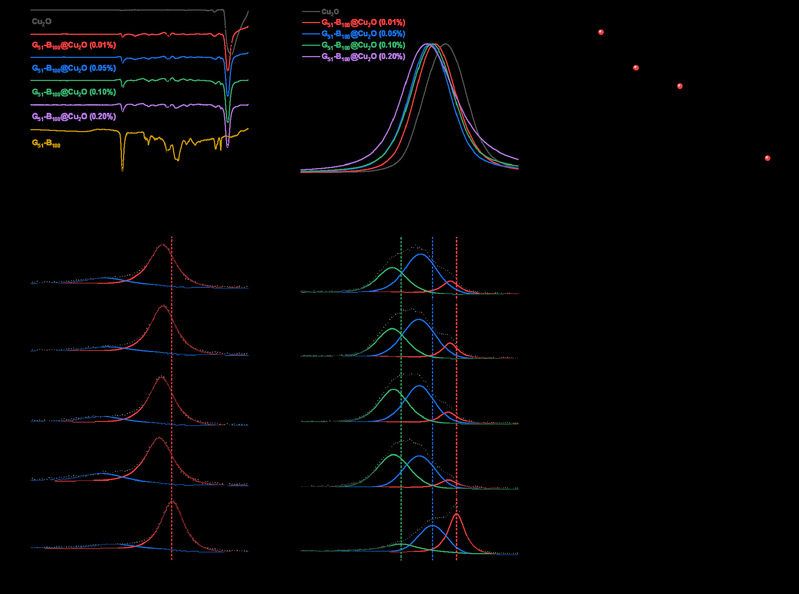
(Figure 5. Microstructural analysis of G51-B100@Cu₂O composite crystals. (a) FT-IR spectra; (b) Synchrotron XRD patterns showing lattice contraction; (c) Lattice distortion as a function of G51-B100 concentration; (d–e) XPS spectra of Cu 2p₃/₂ and O 1s; (f) Cu LMM Auger spectra.)
Catalytic tests demonstrated that the G51-B100@Cu₂O composite crystals could efficiently degrade methyl orange (MO) dye in the dark, with activity positively correlated with the degree of nanoparticle embedding (Figure 6). In contrast, neither pure Cu₂O crystals nor G51-B100 nanoparticles alone showed such activity. The composite catalyst also exhibited excellent stability, maintaining over 95% degradation efficiency after ten consecutive cycles.
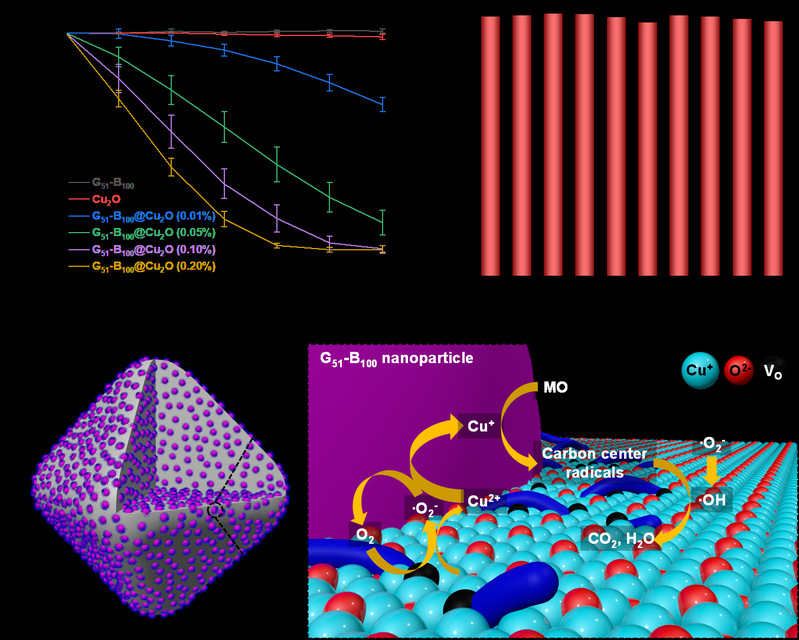
(Figure 6. Dark catalytic performance of G51-B100@Cu₂O composite crystals. (a) Comparison of MO degradation rates among different samples; (b) Recycling test; (c) Proposed degradation mechanism.)
In summary, this study introduces a general nanoparticle occlusion strategy for spatially engineering the internal microstructure of single crystals. The resulting defects, including oxygen vacancies and lattice distortions, enable efficient dye degradation in the dark without external energy input. Beyond dark catalysis, this approach shows promise for applications in electrocatalysis, heterogeneous catalysis, and sensing technologies where precise defect control is critical.
This research was supported by the National Young Talent Program, the National Natural Science Foundation of China, the Guangdong Basic and Applied Basic Research Foundation, and Jinan University.
Link to the paper: https://doi.org/10.1002/anie.202505637
NEWS
- About the University
- Quick Links

Copyright © 2016 Jinan University. All Rights Reserved.